In the modern world, a person is experiencing less joy.
Bishop of Western Europe Justin in an exclusive interview for "News" ahead of Christmas
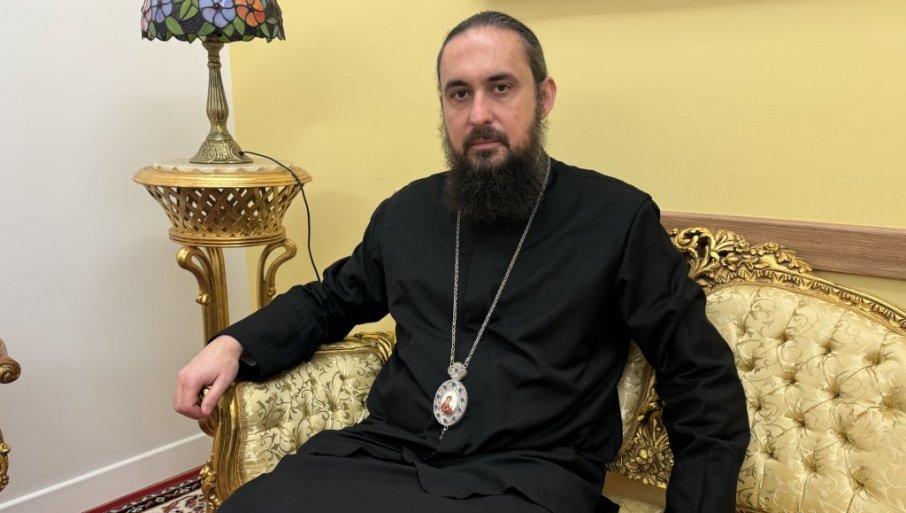


What is a holiday? A timeless question that seeks a constant and renewed answer, especially today when there is a serious crisis in its understanding. We live in the age of postmodernism, and the world around us rejoices less and less; in man, his very important characteristic "homo adorans", the being of celebration and joy, is erased, and life passes filled with fear, anxiety, and worry! Holidays become just "small pauses" in an otherwise meaningless, burdensome, and work-laden time and life.
What message would you send before the upcoming holidays?
– The meaning of the holiday today is reduced to a sociological, social, and, I would say, consumer level. Unfortunately, too much euphoria without any reason, too many expectations without any deeper meaning! Holiday days are experienced as a "blank day", as a day of "recreation", "idleness", exchanging gifts. For a moment, everything changes: houses, streets, squares, splendor and wealth appear where poverty usually reigns, a truce occurs where there is war. However, the liturgical holidays of the birth of the Lord Jesus Christ and the New Year have a much deeper dimension. For Orthodox understanding, it is primarily a holiday of true joy: God became man, a way of giving meaning and significance to one’s existence appeared, transforming overall life and work into joy.
The feast of Christ's birth is an event of the church community, an expression of man's need to meet Him and step out of the natural order of things, an expectation, not only of a better world and life. And all this can be experienced through liturgical celebration. A holiday without Liturgy is deprived of its essence and meaning, or its meaning is re-evaluated. In this context, the holiday ceases to be a "mere remembrance" of long-past events and becomes an experience of what is yet to come, and what we should already live here and now: eternal life in communion with God and neighbors.
Of course, that does not mean that holidays should be deprived of the festive celebration that happens in the "Liturgy after Liturgy". The holiday loses its vitality if it is torn away from customs, games, entertainment, folk tradition, and joy, but it loses its meaning if it is reduced only to that. Therefore, my message is to believe that Christ is born, and to begin to live that truth in our everyday life, and we will see how everything will gain its full meaning and beauty.
• What do we most need at this moment in the world?
– A lot! It seems to me that the key word is peace. Peace within us and around us, which is, in fact, inseparably connected. The world is in a vicious circle and eternal return to the same: military, economic, political, psychological, "cold", and bloody wars are waged. It has almost become a rule: hatred for hatred, violence for violence, provocation for provocation… Everyone thinks they are innocent, and that the other is the culprit. Sin is promoted, and virtue is mocked, lies are proclaimed as truth, and darkness as light! Everyone defends their interests and goals, and the rights and freedoms of others are voiced as a pretext for conflict.
And therefore, speaking from the position of a Bishop of the Orthodox Church, I think that what is, or rather Who is most needed today, but also always, is – Christ, the eternal and only righteous peace. And it is up to us, Christians, to make Christ visibly present in this world and time with our lives. Christians are the icons through which Christ – His word and logic – is manifested to the world.
Our Most Holy Patriarch Porfirije often quotes a wonderful patristic thought: "If Christ is first in our lives, everything else will fall into place." And it really is so. Through Christ and with Christ, we will be capable first and foremost to conquer evil within ourselves, and then, as such, we will be able to resist both hatred and violence in the world – and that in a Christ-like manner, essentially, existentially, and not just verbally. Only "new men", living followers of Christ, can restore hope and break the almost unbearable vicious circle I spoke of at the beginning, helping to establish a new vision and perspective of the world and man. Without exaggeration, we can say that the Church of Christ is the true alternative to the world and the fundamentally only way out.
The first step is certainly to believe in Him, to adopt the logic of the right thief who acknowledged his own guilt and responsibility and thus became the first of all men to enter paradise.
Hatred cannot be eradicated by hatred, nor violence by violence. They are conquered and eradicated through love and the peace of Christ, which we, as Orthodox Christians, are called to bear witness to. And perhaps someone will say: all this is a utopia that this Bishop talks about and almost unattainable in real life, but just imagine how terrible a place for living this world would be if such possibilities did not exist!
Thus, what is most needed for all of us is repentance, personal self-restraint, and turning to the other who is a brother, never an enemy, whom we must not sacrifice even for the "most sacred goals".
• Where is the Serbian ship sailing in turbulent world times?
– The history of the Serbian people resembles a long voyage through turbulent waters. There have been moments when we faltered and lost strength, but not meaning; when we lost our state, but not our soul and honor. The Serbian people have often sailed between Scylla and Charybdis, but they have not sailed without a compass, and that is what is most important. The problem is not in the turbulent sea, but in the loss of orientation and direction. If we guard against that, the ship will survive. And our compass, direction, and path are the God-Man Christ and Saint Sava, the ancient Christian, Kosovo-Metohija tradition. Thanks to Orthodox self-awareness, our people have endured even in the moments of the greatest trials, for the ultimate goal has always been Heavenly Serbia and the Kingdom of Heaven, because they knew that "earthly is too little".
This, of course, does not mean that it lacked patriotism and love for the homeland. On the contrary! For faith and the homeland, "for the honorable cross and the golden freedom," life was not expensive for the Serbs. Our love for the homeland has always derived from our love for God. Today, the challenges are numerous and complex: both external and internal; we are burdened by terrible divisions and discord, faced with an extremely unfavorable external environment and geopolitical situation in the world. A heavy burden has fallen on our weak shoulders!
Our strength, however, lies in our unity, and we must constantly remind and call for that, no matter how impossible it may seem. The Serbian people have no better foundation and content of unity, which yields better results, than unity in faith and truth. That is a proven method for the Serbian nation to stay on its path and bear fruits worthy of its ancestors and humanity in general. That is a strength that no, no matter how strong wind, can overwhelm! It is no wonder that Saint Bishop Nikolaj said: "Only harmony saves Serbs!"
You live outside the homeland and have the opportunity to see what we can gain from the world?
– Living abroad, one can see more clearly what we carry within ourselves, but also what we are missing. First, I think the world has become one big village, where certain models of behavior, thought, and relationships assume a universal character. The external differences between people here and there, in the homeland, are becoming less noticeable. However, it is important to always be like a bee, and not like a fly, as the holy elder Paisios of the Holy Mountain said: to take the most beautiful nectar from each flower. This does not mean mere imitation or self-denial but, on the contrary: deeply rooted in our own tradition and rich history and culture, we can take from here what this, also rich culture and tradition, which, incidentally, is essentially Christian, offers.
From the world in which we live, we can and should take a sense of responsibility, order, and respect for the other as a person. The world in which we live obliges us and reminds us that faith or national belonging must not be an excuse for negligence, idleness, or closed-mindedness. We can learn how to better organize our community, how to be consistent in our obligations, and how to develop a culture of dialogue, without fear of diversity. All of this, however, makes sense only if it does not lead to a loss of the spiritual foundation, for order, that, I would say, horizontal, without the vertical, without a spiritual pillar, becomes cold, and freedom without truth turns into a new slavery.
And what can we offer the world?
– First of all, the most beautiful Orthodox faith. The experience that a person is not reduced to function, success, or consumer, that you are not good and worth something only if you are useful. We can testify that suffering is not the final word, that sacrifice has meaning, and that dignity is preserved even when a person, seen from the outside, is weak.
Our people carry within themselves the experience of faith that is not theory but a living life; faith that has survived in moments of trials, dispersion, and losses. The birth of Christ reminds us precisely of this: God appears not in strength but in fragility; not in power and excessive glamour but in the silence and simplicity of the Bethlehem cave. If we, as a people, can live and testify to this, then we have something to offer the world – not as superiority but as a gift.
• How much are our people abroad guardians of the Serbian name in the world?
– Certainly, we are all called, and all of us, in a certain way, testify to our origin and create an image of our entire nation before the world. First of all, we should recall wonderful examples from our glorious history, such as Mihajlo Pupin, Jovan Dučić, Mileva Marić, the great Nikola Tesla, and many others known and unknown… It should be noted that Pupin added "Idvorski" (the place of his birth, Idvor in Banat) to his name to highlight his origin even more clearly. During World War I, he undertook a comprehensive campaign – I won’t say lobbying, but informing the American public of the great sacrifice and suffering of small Serbia and the Serbian people. He sent humanitarian and financial aid. With his property, he guaranteed to the American government that Serbia would receive a war loan. Tesla emphasized how proud he was of his Serbian origin, and according to his personal desire, the song of Serbian warriors "Tamo daleko" was played at his funeral.
What do I want to say with this? By highlighting these examples, we actually realize that the world learned about us through the deeds of individuals, and that these very individuals are witnesses, guardians, and promoters of the Serbian name in the world. We identify with them; they make us proud and remind us that we are of one – Serbian nationality and origin.
Here, the question of identity and its preservation in the diaspora naturally arises. We have plenty of examples, and we in the Church often encounter such questions about identity. We live in a French society. We use the French language, of course! Our children go to French schools, listen to lectures, mostly have French friends, and at one point, the ontological question arises, especially in adolescence: who am I? Am I French, which my environment somewhat imposes, or am I Serbian, as my parents say? Especially if the Serbian language is not spoken in the family, which is, unfortunately, mostly the case in families of the third and fourth generation of immigrants, children have almost no contacts with Serbian identity and Serbian origin.
Here, the Church has a very important place. Although the Church has a missionary character and addresses its surroundings in which it exists, inviting them with evangelical words in their language, it also keeps and reminds all of us that we are descendants of Saint Sava, the greatest Serb of all time, as Saint Bishop Nikolaj said, a heritage we should be proud of and testify to others. The Church helps us integrate more easily here, but at the same time protects us from assimilation.
Let us therefore keep our Church, which has always been with the people; let us keep our language, history, and culture, so that we know who we are, for others to respect us, but above all to preserve ourselves.
• As a nation, we have often divided on various grounds throughout history. How has this harmed us and how can we overcome this fate?
– Unfortunately, divisions have taken a lot of strength from us and left, and still leave, deep scars. I do not know why, but it is some evil fate that lives in our people and exhausts it terribly! I am reminded of Dušan Kovačević's book "Twenty Serbian Divisions"… oh, if there were only twenty! Then there's Ćosić's "Divisions"… Thus, many smarter than me have not managed to answer this question; it is hard for me to succeed.
What I can possibly offer as a mitigating circumstance is the fact that we are witnesses of deep divisions in societies around the world. Regardless of whether the division occurs in politics, education, religion, or culture, even in families, each side has strong proponents and arguments, as well as equally strong opponents.
The role of the Church is not to be somewhere "in between" the divided sides, but to aim to remain above both and do what our Most Holy Patriarch does from the throne of Saint Sava today: to call for peace, repentance, building bridges, and mutual respect. Recently, in a conversation with a wise person, I heard a very interesting thought: they ask the Church to take sides with this or that side, he says, but who will reconcile us if that happens? And it really is so!
• At the Serbian Military Cemetery in Thieu, you reminded us of the sacrifice of the heroes buried here, there, "on the French Corfu, small Kačanik, Thessaloniki, in Paris." What should this sacrifice remind us of?
– I wanted to remind us that the sacrifice of the hero-soldiers buried there, but also everywhere where the bones of Serbian soldiers are scattered around the world, must never be devalued. The freedom for which they fought is not the freedom of another but the freedom for timeless human values, for humanity. Let us appreciate that and be worthy descendants of glorious ancestors.
And finally, I wish all people, wherever they may live, happy and blessed upcoming holidays, reminding them always to keep in mind Christ's words: "Do not be afraid, only believe!"
Respect for "Novosti"
In my childhood, I still remember my father reading the "Evening News". To me as a child, it was endearing with its joyful, red logo. I remember my mother coming from the store with a bag containing bread, milk, and some breakfast, and invariably "Evening News". And that famous opening, their excitement about what they would discover inside, and the smell of the newspaper print has stayed in my nostrils to this day. I have a special respect for "Evening News".
Source: Novosti
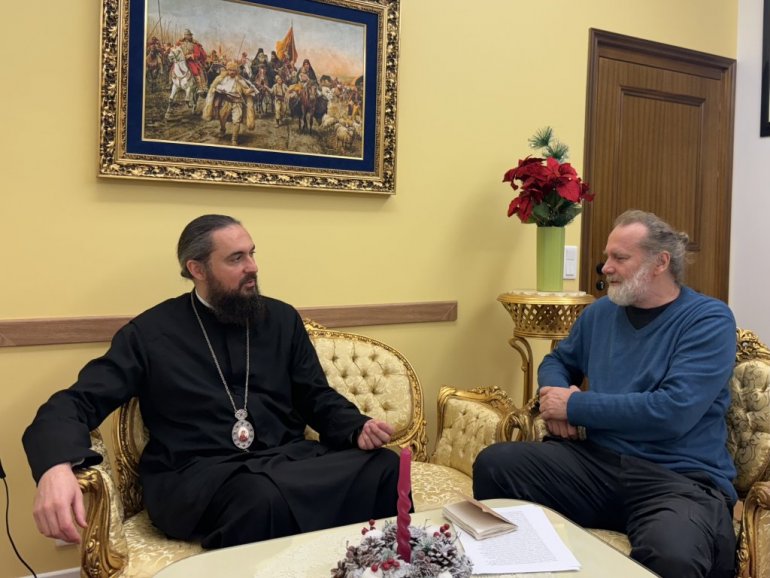
What is a holiday? A timeless question that seeks a constant and renewed answer, especially today when there is a serious crisis in its understanding. We live in the age of postmodernism, and the world around us rejoices less and less; in man, his very important characteristic "homo adorans", the being of celebration and joy, is erased, and life passes filled with fear, anxiety, and worry! Holidays become just "small pauses" in an otherwise meaningless, burdensome, and work-laden time and life.
What message would you send before the upcoming holidays?
– The meaning of the holiday today is reduced to a sociological, social, and, I would say, consumer level. Unfortunately, too much euphoria without any reason, too many expectations without any deeper meaning! Holiday days are experienced as a "blank day", as a day of "recreation", "idleness", exchanging gifts. For a moment, everything changes: houses, streets, squares, splendor and wealth appear where poverty usually reigns, a truce occurs where there is war. However, the liturgical holidays of the birth of the Lord Jesus Christ and the New Year have a much deeper dimension. For Orthodox understanding, it is primarily a holiday of true joy: God became man, a way of giving meaning and significance to one’s existence appeared, transforming overall life and work into joy.
The feast of Christ's birth is an event of the church community, an expression of man's need to meet Him and step out of the natural order of things, an expectation, not only of a better world and life. And all this can be experienced through liturgical celebration. A holiday without Liturgy is deprived of its essence and meaning, or its meaning is re-evaluated. In this context, the holiday ceases to be a "mere remembrance" of long-past events and becomes an experience of what is yet to come, and what we should already live here and now: eternal life in communion with God and neighbors.
Of course, that does not mean that holidays should be deprived of the festive celebration that happens in the "Liturgy after Liturgy". The holiday loses its vitality if it is torn away from customs, games, entertainment, folk tradition, and joy, but it loses its meaning if it is reduced only to that. Therefore, my message is to believe that Christ is born, and to begin to live that truth in our everyday life, and we will see how everything will gain its full meaning and beauty.
• What do we most need at this moment in the world?
– A lot! It seems to me that the key word is peace. Peace within us and around us, which is, in fact, inseparably connected. The world is in a vicious circle and eternal return to the same: military, economic, political, psychological, "cold", and bloody wars are waged. It has almost become a rule: hatred for hatred, violence for violence, provocation for provocation… Everyone thinks they are innocent, and that the other is the culprit. Sin is promoted, and virtue is mocked, lies are proclaimed as truth, and darkness as light! Everyone defends their interests and goals, and the rights and freedoms of others are voiced as a pretext for conflict.
And therefore, speaking from the position of a Bishop of the Orthodox Church, I think that what is, or rather Who is most needed today, but also always, is – Christ, the eternal and only righteous peace. And it is up to us, Christians, to make Christ visibly present in this world and time with our lives. Christians are the icons through which Christ – His word and logic – is manifested to the world.
Our Most Holy Patriarch Porfirije often quotes a wonderful patristic thought: "If Christ is first in our lives, everything else will fall into place." And it really is so. Through Christ and with Christ, we will be capable first and foremost to conquer evil within ourselves, and then, as such, we will be able to resist both hatred and violence in the world – and that in a Christ-like manner, essentially, existentially, and not just verbally. Only "new men", living followers of Christ, can restore hope and break the almost unbearable vicious circle I spoke of at the beginning, helping to establish a new vision and perspective of the world and man. Without exaggeration, we can say that the Church of Christ is the true alternative to the world and the fundamentally only way out.
The first step is certainly to believe in Him, to adopt the logic of the right thief who acknowledged his own guilt and responsibility and thus became the first of all men to enter paradise.
Hatred cannot be eradicated by hatred, nor violence by violence. They are conquered and eradicated through love and the peace of Christ, which we, as Orthodox Christians, are called to bear witness to. And perhaps someone will say: all this is a utopia that this Bishop talks about and almost unattainable in real life, but just imagine how terrible a place for living this world would be if such possibilities did not exist!
Thus, what is most needed for all of us is repentance, personal self-restraint, and turning to the other who is a brother, never an enemy, whom we must not sacrifice even for the "most sacred goals".
• Where is the Serbian ship sailing in turbulent world times?
– The history of the Serbian people resembles a long voyage through turbulent waters. There have been moments when we faltered and lost strength, but not meaning; when we lost our state, but not our soul and honor. The Serbian people have often sailed between Scylla and Charybdis, but they have not sailed without a compass, and that is what is most important. The problem is not in the turbulent sea, but in the loss of orientation and direction. If we guard against that, the ship will survive. And our compass, direction, and path are the God-Man Christ and Saint Sava, the ancient Christian, Kosovo-Metohija tradition. Thanks to Orthodox self-awareness, our people have endured even in the moments of the greatest trials, for the ultimate goal has always been Heavenly Serbia and the Kingdom of Heaven, because they knew that "earthly is too little".
This, of course, does not mean that it lacked patriotism and love for the homeland. On the contrary! For faith and the homeland, "for the honorable cross and the golden freedom," life was not expensive for the Serbs. Our love for the homeland has always derived from our love for God. Today, the challenges are numerous and complex: both external and internal; we are burdened by terrible divisions and discord, faced with an extremely unfavorable external environment and geopolitical situation in the world. A heavy burden has fallen on our weak shoulders!
Our strength, however, lies in our unity, and we must constantly remind and call for that, no matter how impossible it may seem. The Serbian people have no better foundation and content of unity, which yields better results, than unity in faith and truth. That is a proven method for the Serbian nation to stay on its path and bear fruits worthy of its ancestors and humanity in general. That is a strength that no, no matter how strong wind, can overwhelm! It is no wonder that Saint Bishop Nikolaj said: "Only harmony saves Serbs!"
You live outside the homeland and have the opportunity to see what we can gain from the world?
– Living abroad, one can see more clearly what we carry within ourselves, but also what we are missing. First, I think the world has become one big village, where certain models of behavior, thought, and relationships assume a universal character. The external differences between people here and there, in the homeland, are becoming less noticeable. However, it is important to always be like a bee, and not like a fly, as the holy elder Paisios of the Holy Mountain said: to take the most beautiful nectar from each flower. This does not mean mere imitation or self-denial but, on the contrary: deeply rooted in our own tradition and rich history and culture, we can take from here what this, also rich culture and tradition, which, incidentally, is essentially Christian, offers.
From the world in which we live, we can and should take a sense of responsibility, order, and respect for the other as a person. The world in which we live obliges us and reminds us that faith or national belonging must not be an excuse for negligence, idleness, or closed-mindedness. We can learn how to better organize our community, how to be consistent in our obligations, and how to develop a culture of dialogue, without fear of diversity. All of this, however, makes sense only if it does not lead to a loss of the spiritual foundation, for order, that, I would say, horizontal, without the vertical, without a spiritual pillar, becomes cold, and freedom without truth turns into a new slavery.
And what can we offer the world?
– First of all, the most beautiful Orthodox faith. The experience that a person is not reduced to function, success, or consumer, that you are not good and worth something only if you are useful. We can testify that suffering is not the final word, that sacrifice has meaning, and that dignity is preserved even when a person, seen from the outside, is weak.
Our people carry within themselves the experience of faith that is not theory but a living life; faith that has survived in moments of trials, dispersion, and losses. The birth of Christ reminds us precisely of this: God appears not in strength but in fragility; not in power and excessive glamour but in the silence and simplicity of the Bethlehem cave. If we, as a people, can live and testify to this, then we have something to offer the world – not as superiority but as a gift.
• How much are our people abroad guardians of the Serbian name in the world?
– Certainly, we are all called, and all of us, in a certain way, testify to our origin and create an image of our entire nation before the world. First of all, we should recall wonderful examples from our glorious history, such as Mihajlo Pupin, Jovan Dučić, Mileva Marić, the great Nikola Tesla, and many others known and unknown… It should be noted that Pupin added "Idvorski" (the place of his birth, Idvor in Banat) to his name to highlight his origin even more clearly. During World War I, he undertook a comprehensive campaign – I won’t say lobbying, but informing the American public of the great sacrifice and suffering of small Serbia and the Serbian people. He sent humanitarian and financial aid. With his property, he guaranteed to the American government that Serbia would receive a war loan. Tesla emphasized how proud he was of his Serbian origin, and according to his personal desire, the song of Serbian warriors "Tamo daleko" was played at his funeral.
What do I want to say with this? By highlighting these examples, we actually realize that the world learned about us through the deeds of individuals, and that these very individuals are witnesses, guardians, and promoters of the Serbian name in the world. We identify with them; they make us proud and remind us that we are of one – Serbian nationality and origin.
Here, the question of identity and its preservation in the diaspora naturally arises. We have plenty of examples, and we in the Church often encounter such questions about identity. We live in a French society. We use the French language, of course! Our children go to French schools, listen to lectures, mostly have French friends, and at one point, the ontological question arises, especially in adolescence: who am I? Am I French, which my environment somewhat imposes, or am I Serbian, as my parents say? Especially if the Serbian language is not spoken in the family, which is, unfortunately, mostly the case in families of the third and fourth generation of immigrants, children have almost no contacts with Serbian identity and Serbian origin.
Here, the Church has a very important place. Although the Church has a missionary character and addresses its surroundings in which it exists, inviting them with evangelical words in their language, it also keeps and reminds all of us that we are descendants of Saint Sava, the greatest Serb of all time, as Saint Bishop Nikolaj said, a heritage we should be proud of and testify to others. The Church helps us integrate more easily here, but at the same time protects us from assimilation.
Let us therefore keep our Church, which has always been with the people; let us keep our language, history, and culture, so that we know who we are, for others to respect us, but above all to preserve ourselves.
• As a nation, we have often divided on various grounds throughout history. How has this harmed us and how can we overcome this fate?
– Unfortunately, divisions have taken a lot of strength from us and left, and still leave, deep scars. I do not know why, but it is some evil fate that lives in our people and exhausts it terribly! I am reminded of Dušan Kovačević's book "Twenty Serbian Divisions"… oh, if there were only twenty! Then there's Ćosić's "Divisions"… Thus, many smarter than me have not managed to answer this question; it is hard for me to succeed.
What I can possibly offer as a mitigating circumstance is the fact that we are witnesses of deep divisions in societies around the world. Regardless of whether the division occurs in politics, education, religion, or culture, even in families, each side has strong proponents and arguments, as well as equally strong opponents.
The role of the Church is not to be somewhere "in between" the divided sides, but to aim to remain above both and do what our Most Holy Patriarch does from the throne of Saint Sava today: to call for peace, repentance, building bridges, and mutual respect. Recently, in a conversation with a wise person, I heard a very interesting thought: they ask the Church to take sides with this or that side, he says, but who will reconcile us if that happens? And it really is so!
• At the Serbian Military Cemetery in Thieu, you reminded us of the sacrifice of the heroes buried here, there, "on the French Corfu, small Kačanik, Thessaloniki, in Paris." What should this sacrifice remind us of?
– I wanted to remind us that the sacrifice of the hero-soldiers buried there, but also everywhere where the bones of Serbian soldiers are scattered around the world, must never be devalued. The freedom for which they fought is not the freedom of another but the freedom for timeless human values, for humanity. Let us appreciate that and be worthy descendants of glorious ancestors.
And finally, I wish all people, wherever they may live, happy and blessed upcoming holidays, reminding them always to keep in mind Christ's words: "Do not be afraid, only believe!"
Respect for "Novosti"
In my childhood, I still remember my father reading the "Evening News". To me as a child, it was endearing with its joyful, red logo. I remember my mother coming from the store with a bag containing bread, milk, and some breakfast, and invariably "Evening News". And that famous opening, their excitement about what they would discover inside, and the smell of the newspaper print has stayed in my nostrils to this day. I have a special respect for "Evening News".
Source: Novosti

What is a holiday? A timeless question that seeks a constant and renewed answer, especially today when there is a serious crisis in its understanding. We live in the age of postmodernism, and the world around us rejoices less and less; in man, his very important characteristic "homo adorans", the being of celebration and joy, is erased, and life passes filled with fear, anxiety, and worry! Holidays become just "small pauses" in an otherwise meaningless, burdensome, and work-laden time and life.
What message would you send before the upcoming holidays?
– The meaning of the holiday today is reduced to a sociological, social, and, I would say, consumer level. Unfortunately, too much euphoria without any reason, too many expectations without any deeper meaning! Holiday days are experienced as a "blank day", as a day of "recreation", "idleness", exchanging gifts. For a moment, everything changes: houses, streets, squares, splendor and wealth appear where poverty usually reigns, a truce occurs where there is war. However, the liturgical holidays of the birth of the Lord Jesus Christ and the New Year have a much deeper dimension. For Orthodox understanding, it is primarily a holiday of true joy: God became man, a way of giving meaning and significance to one’s existence appeared, transforming overall life and work into joy.
The feast of Christ's birth is an event of the church community, an expression of man's need to meet Him and step out of the natural order of things, an expectation, not only of a better world and life. And all this can be experienced through liturgical celebration. A holiday without Liturgy is deprived of its essence and meaning, or its meaning is re-evaluated. In this context, the holiday ceases to be a "mere remembrance" of long-past events and becomes an experience of what is yet to come, and what we should already live here and now: eternal life in communion with God and neighbors.
Of course, that does not mean that holidays should be deprived of the festive celebration that happens in the "Liturgy after Liturgy". The holiday loses its vitality if it is torn away from customs, games, entertainment, folk tradition, and joy, but it loses its meaning if it is reduced only to that. Therefore, my message is to believe that Christ is born, and to begin to live that truth in our everyday life, and we will see how everything will gain its full meaning and beauty.
• What do we most need at this moment in the world?
– A lot! It seems to me that the key word is peace. Peace within us and around us, which is, in fact, inseparably connected. The world is in a vicious circle and eternal return to the same: military, economic, political, psychological, "cold", and bloody wars are waged. It has almost become a rule: hatred for hatred, violence for violence, provocation for provocation… Everyone thinks they are innocent, and that the other is the culprit. Sin is promoted, and virtue is mocked, lies are proclaimed as truth, and darkness as light! Everyone defends their interests and goals, and the rights and freedoms of others are voiced as a pretext for conflict.
And therefore, speaking from the position of a Bishop of the Orthodox Church, I think that what is, or rather Who is most needed today, but also always, is – Christ, the eternal and only righteous peace. And it is up to us, Christians, to make Christ visibly present in this world and time with our lives. Christians are the icons through which Christ – His word and logic – is manifested to the world.
Our Most Holy Patriarch Porfirije often quotes a wonderful patristic thought: "If Christ is first in our lives, everything else will fall into place." And it really is so. Through Christ and with Christ, we will be capable first and foremost to conquer evil within ourselves, and then, as such, we will be able to resist both hatred and violence in the world – and that in a Christ-like manner, essentially, existentially, and not just verbally. Only "new men", living followers of Christ, can restore hope and break the almost unbearable vicious circle I spoke of at the beginning, helping to establish a new vision and perspective of the world and man. Without exaggeration, we can say that the Church of Christ is the true alternative to the world and the fundamentally only way out.
The first step is certainly to believe in Him, to adopt the logic of the right thief who acknowledged his own guilt and responsibility and thus became the first of all men to enter paradise.
Hatred cannot be eradicated by hatred, nor violence by violence. They are conquered and eradicated through love and the peace of Christ, which we, as Orthodox Christians, are called to bear witness to. And perhaps someone will say: all this is a utopia that this Bishop talks about and almost unattainable in real life, but just imagine how terrible a place for living this world would be if such possibilities did not exist!
Thus, what is most needed for all of us is repentance, personal self-restraint, and turning to the other who is a brother, never an enemy, whom we must not sacrifice even for the "most sacred goals".
• Where is the Serbian ship sailing in turbulent world times?
– The history of the Serbian people resembles a long voyage through turbulent waters. There have been moments when we faltered and lost strength, but not meaning; when we lost our state, but not our soul and honor. The Serbian people have often sailed between Scylla and Charybdis, but they have not sailed without a compass, and that is what is most important. The problem is not in the turbulent sea, but in the loss of orientation and direction. If we guard against that, the ship will survive. And our compass, direction, and path are the God-Man Christ and Saint Sava, the ancient Christian, Kosovo-Metohija tradition. Thanks to Orthodox self-awareness, our people have endured even in the moments of the greatest trials, for the ultimate goal has always been Heavenly Serbia and the Kingdom of Heaven, because they knew that "earthly is too little".
This, of course, does not mean that it lacked patriotism and love for the homeland. On the contrary! For faith and the homeland, "for the honorable cross and the golden freedom," life was not expensive for the Serbs. Our love for the homeland has always derived from our love for God. Today, the challenges are numerous and complex: both external and internal; we are burdened by terrible divisions and discord, faced with an extremely unfavorable external environment and geopolitical situation in the world. A heavy burden has fallen on our weak shoulders!
Our strength, however, lies in our unity, and we must constantly remind and call for that, no matter how impossible it may seem. The Serbian people have no better foundation and content of unity, which yields better results, than unity in faith and truth. That is a proven method for the Serbian nation to stay on its path and bear fruits worthy of its ancestors and humanity in general. That is a strength that no, no matter how strong wind, can overwhelm! It is no wonder that Saint Bishop Nikolaj said: "Only harmony saves Serbs!"
You live outside the homeland and have the opportunity to see what we can gain from the world?
– Living abroad, one can see more clearly what we carry within ourselves, but also what we are missing. First, I think the world has become one big village, where certain models of behavior, thought, and relationships assume a universal character. The external differences between people here and there, in the homeland, are becoming less noticeable. However, it is important to always be like a bee, and not like a fly, as the holy elder Paisios of the Holy Mountain said: to take the most beautiful nectar from each flower. This does not mean mere imitation or self-denial but, on the contrary: deeply rooted in our own tradition and rich history and culture, we can take from here what this, also rich culture and tradition, which, incidentally, is essentially Christian, offers.
From the world in which we live, we can and should take a sense of responsibility, order, and respect for the other as a person. The world in which we live obliges us and reminds us that faith or national belonging must not be an excuse for negligence, idleness, or closed-mindedness. We can learn how to better organize our community, how to be consistent in our obligations, and how to develop a culture of dialogue, without fear of diversity. All of this, however, makes sense only if it does not lead to a loss of the spiritual foundation, for order, that, I would say, horizontal, without the vertical, without a spiritual pillar, becomes cold, and freedom without truth turns into a new slavery.
And what can we offer the world?
– First of all, the most beautiful Orthodox faith. The experience that a person is not reduced to function, success, or consumer, that you are not good and worth something only if you are useful. We can testify that suffering is not the final word, that sacrifice has meaning, and that dignity is preserved even when a person, seen from the outside, is weak.
Our people carry within themselves the experience of faith that is not theory but a living life; faith that has survived in moments of trials, dispersion, and losses. The birth of Christ reminds us precisely of this: God appears not in strength but in fragility; not in power and excessive glamour but in the silence and simplicity of the Bethlehem cave. If we, as a people, can live and testify to this, then we have something to offer the world – not as superiority but as a gift.
• How much are our people abroad guardians of the Serbian name in the world?
– Certainly, we are all called, and all of us, in a certain way, testify to our origin and create an image of our entire nation before the world. First of all, we should recall wonderful examples from our glorious history, such as Mihajlo Pupin, Jovan Dučić, Mileva Marić, the great Nikola Tesla, and many others known and unknown… It should be noted that Pupin added "Idvorski" (the place of his birth, Idvor in Banat) to his name to highlight his origin even more clearly. During World War I, he undertook a comprehensive campaign – I won’t say lobbying, but informing the American public of the great sacrifice and suffering of small Serbia and the Serbian people. He sent humanitarian and financial aid. With his property, he guaranteed to the American government that Serbia would receive a war loan. Tesla emphasized how proud he was of his Serbian origin, and according to his personal desire, the song of Serbian warriors "Tamo daleko" was played at his funeral.
What do I want to say with this? By highlighting these examples, we actually realize that the world learned about us through the deeds of individuals, and that these very individuals are witnesses, guardians, and promoters of the Serbian name in the world. We identify with them; they make us proud and remind us that we are of one – Serbian nationality and origin.
Here, the question of identity and its preservation in the diaspora naturally arises. We have plenty of examples, and we in the Church often encounter such questions about identity. We live in a French society. We use the French language, of course! Our children go to French schools, listen to lectures, mostly have French friends, and at one point, the ontological question arises, especially in adolescence: who am I? Am I French, which my environment somewhat imposes, or am I Serbian, as my parents say? Especially if the Serbian language is not spoken in the family, which is, unfortunately, mostly the case in families of the third and fourth generation of immigrants, children have almost no contacts with Serbian identity and Serbian origin.
Here, the Church has a very important place. Although the Church has a missionary character and addresses its surroundings in which it exists, inviting them with evangelical words in their language, it also keeps and reminds all of us that we are descendants of Saint Sava, the greatest Serb of all time, as Saint Bishop Nikolaj said, a heritage we should be proud of and testify to others. The Church helps us integrate more easily here, but at the same time protects us from assimilation.
Let us therefore keep our Church, which has always been with the people; let us keep our language, history, and culture, so that we know who we are, for others to respect us, but above all to preserve ourselves.
• As a nation, we have often divided on various grounds throughout history. How has this harmed us and how can we overcome this fate?
– Unfortunately, divisions have taken a lot of strength from us and left, and still leave, deep scars. I do not know why, but it is some evil fate that lives in our people and exhausts it terribly! I am reminded of Dušan Kovačević's book "Twenty Serbian Divisions"… oh, if there were only twenty! Then there's Ćosić's "Divisions"… Thus, many smarter than me have not managed to answer this question; it is hard for me to succeed.
What I can possibly offer as a mitigating circumstance is the fact that we are witnesses of deep divisions in societies around the world. Regardless of whether the division occurs in politics, education, religion, or culture, even in families, each side has strong proponents and arguments, as well as equally strong opponents.
The role of the Church is not to be somewhere "in between" the divided sides, but to aim to remain above both and do what our Most Holy Patriarch does from the throne of Saint Sava today: to call for peace, repentance, building bridges, and mutual respect. Recently, in a conversation with a wise person, I heard a very interesting thought: they ask the Church to take sides with this or that side, he says, but who will reconcile us if that happens? And it really is so!
• At the Serbian Military Cemetery in Thieu, you reminded us of the sacrifice of the heroes buried here, there, "on the French Corfu, small Kačanik, Thessaloniki, in Paris." What should this sacrifice remind us of?
– I wanted to remind us that the sacrifice of the hero-soldiers buried there, but also everywhere where the bones of Serbian soldiers are scattered around the world, must never be devalued. The freedom for which they fought is not the freedom of another but the freedom for timeless human values, for humanity. Let us appreciate that and be worthy descendants of glorious ancestors.
And finally, I wish all people, wherever they may live, happy and blessed upcoming holidays, reminding them always to keep in mind Christ's words: "Do not be afraid, only believe!"
Respect for "Novosti"
In my childhood, I still remember my father reading the "Evening News". To me as a child, it was endearing with its joyful, red logo. I remember my mother coming from the store with a bag containing bread, milk, and some breakfast, and invariably "Evening News". And that famous opening, their excitement about what they would discover inside, and the smell of the newspaper print has stayed in my nostrils to this day. I have a special respect for "Evening News".
Source: Novosti
